
Choosing the right Glass Bottle Stopper in 2026 requires more than comparing appearance and price. Global buyers must examine sealing performance, neck-finish compatibility, material safety, supply stability, and environmental expectations. A stopper that looks elegant may still leak under pressure, loosen during transport, or absorb product aromas. Small details matter.
As cork-industry leader António Amorim has stated, “Cork is a natural product, and every piece is different.” This observation also applies to stopper selection. Natural cork, synthetic cork, T-top, bar-top, glass, rubber, and hybrid designs each offer different advantages. Their performance depends on bottle dimensions, filling temperature, storage position, and opening frequency. There is no perfect stopper.
This guide compares the most practical Glass Bottle Stopper types for international purchasing teams. It considers sealing reliability, insertion force, removal comfort, customization, recycling potential, and quality-control requirements. It also highlights details that are often missed, including dimensional tolerance, liner behavior, surface defects, and carton protection during long-distance shipping.
Specifications can look convincing.
Yet, real testing remains essential.
Buyers should request samples, measure the bottle finish, and conduct leakage and aging tests before approving large orders. Some recommendations may change as regulations, packaging technology, and consumer preferences develop. That uncertainty deserves attention, not convenient assumptions. A responsible decision balances technical evidence, supplier experience, and the product’s actual use environment.
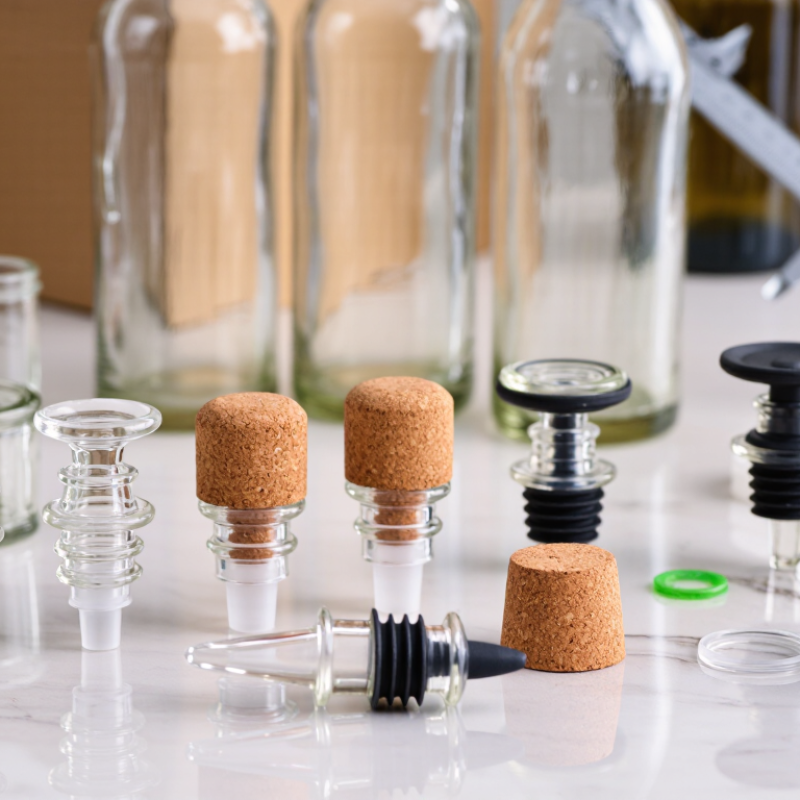
A glass bottle stopper is a closure fitted into a bottle neck to control sealing, pouring, storage, and reuse. Common options include ground-glass stoppers, cork-topped closures, synthetic plugs, and threaded caps. Each type behaves differently under pressure, temperature changes, and repeated handling. A stopper is not merely decoration. It is part of the package’s protection system.
Seal performance matters most. A loose closure can allow oxygen, dust, or moisture to enter. A tight stopper may become difficult to remove. FEVE industry data reports glass container collection and recycling rates above 80% in several European markets, supporting glass’s strong circularity profile. However, the closure can complicate recycling if its materials are difficult to separate.
Buyers should check neck dimensions, insertion force, liner compatibility, and automated filling requirements. Small details cause expensive problems.
In practical testing, a ground-glass stopper feels precise but needs accurate neck finishing. A cork-topped stopper offers a familiar tactile experience, yet natural material can vary.
Synthetic options usually provide more consistency, although they may not suit every product or storage period. Reports from Smithers and other packaging analysts continue to identify barrier performance, sustainability, and convenience as major packaging selection factors.
The imperfect part is often overlooked: laboratory results may not match warehouse handling. Test filled samples through vibration, temperature cycling, and repeated opening before approving a global shipment.
Borosilicate glass handles thermal changes better than ordinary glass. Ordinary glass suits stable room-temperature packaging. Ceramic feels dense and premium. It may vary in size. Natural cork looks traditional but can absorb moisture and odors. Choose materials according to filling conditions and storage climate.
A tapered glass seal can provide a clean friction fit. It requires accurate bottle-neck and stopper dimensions. Silicone or elastomer rings tolerate small surface irregularities. Compare temperature resistance, chemical compatibility, and compression recovery. A narrow seal may look elegant. It can still leak.
Measure the bottle neck with calibrated tools. Check opening diameter, taper, roundness, and sealing depth. Record insertion depth and required removal force. Small dimensional differences can change sealing pressure. Appearance is not enough.
Test samples with heat, cold, vibration, and repeated opening. Use suitable liquids, such as water, oil, or alcohol-based mixtures. Check leakage after transport simulation. Do not inspect only after assembly. Slow leaks are easy to miss.
Inspect at least 30 samples per lot when practical. Use samples from several production lots. Measure dimensions, pull force, insertion depth, odor transfer, and leakage. One perfect sample proves little. Real production can vary.
Request technical drawings, material declarations, food-contact documents, and batch records. Ask for migration test results when relevant. Confirm certificates directly with the issuing organization. Keep sealed reference samples for later comparison. Documents can be incomplete. Check them carefully.
Include rejected units, replacement rings, testing, storage, and freight damage. A low unit price may hide quality losses. Allow budget for retesting. The first sample rarely matches production perfectly. This is easy to underestimate.
Recycled content may reduce material impact. It can also affect color, strength, and process stability. Ask for clear composition and batch information. Compare performance under heat and transport conditions. Sustainability matters, but evidence matters more.
A Glass Bottle Stopper is more than a simple closure; it helps protect product quality, control evaporation, and support a reliable user experience. Its type matters because different designs provide different levels of sealing, convenience, appearance, and compatibility. In 2026, global buyers may compare natural cork, synthetic cork, glass, rubber, silicone, and composite stoppers, as well as designs such as straight, T-shaped, bar-top, screw-fit, and tamper-evident options. Each style should be evaluated according to the bottle neck, filling process, storage conditions, and intended product use.
When selecting a stopper, buyers should compare material safety, dimensional accuracy, sealing performance, chemical resistance, temperature tolerance, reusability, and visual quality. Sourcing decisions should also include production capacity, customization capability, packaging protection, quality-control procedures, and sample testing. Before placing an order, buyers can verify neck dimensions, closure fit, leakage resistance, odor transfer, surface defects, and consistency across batches. A structured comparison helps ensure the chosen stopper is functional, attractive, durable, and suitable for international supply requirements.
