
The 2026 market for large-format wine packaging is becoming more strategic. Global buyers now assess bottle weight, closure compatibility, pallet efficiency, and carbon reporting together. This guide examines leading Wine Bottle Big suppliers through those practical criteria.
The International Organisation of Vine and Wine reported approximately 225.8 million hectolitres of global wine production in 2024. Its April 2025 sector report also described consumption as historically weak. That pressure makes packaging choices more important. A heavy 1.5-litre bottle may signal premium quality, yet it also increases freight emissions, handling costs, and breakage exposure. Buyers need evidence, not appearance.
Glass packaging research from Smithers identifies lightweighting, recycled content, and supply-chain efficiency as major development areas. Wine packaging specialist Jamie Goode has written, “Glass is a wonderful packaging material because it is inert and impermeable.” That remains technically persuasive. It is not the whole answer.
Reliable suppliers should provide furnace origin, recycled-content percentages, bottle drawings, tolerance data, food-contact documentation, and recent export references. Request physical samples. Check the punt depth, neck finish, label panel, and carton fit under warehouse lighting. Small details matter.
A useful comparison should also consider minimum order quantities, mold ownership, lead times, container loading, and breakage claims. Some suppliers publish impressive sustainability figures without explaining their calculation boundaries. That deserves scrutiny. Even respected reports can simplify regional differences, and buyers may overlook the cost of oversized pallets.
This overview highlights 2026 suppliers that combine manufacturing capacity with traceable quality systems, responsive communication, and realistic sustainability evidence. The strongest choice may not be the cheapest bottle. It may be the one that survives the entire journey.
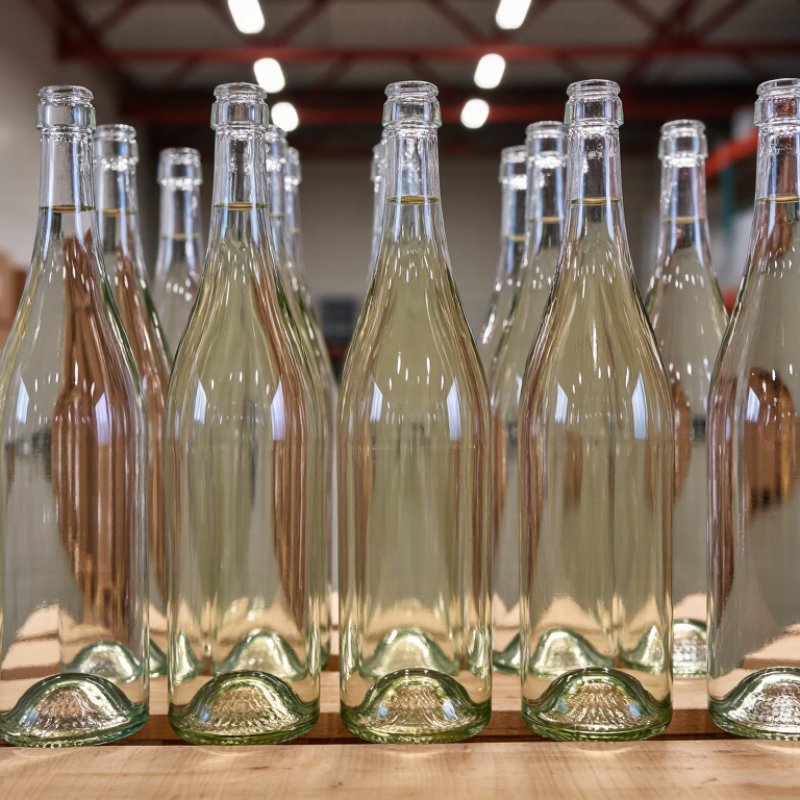
Large wine bottles are selected for storage, presentation, and controlled service. A magnum holds 1.5 liters, equal to two standard bottles. It suits family dinners, restaurant sharing, and small celebrations. Its wider format can support slower maturation because less wine touches the closure relative to volume.
A jeroboam usually holds 3 liters, although its meaning can vary by region and wine category. It is common at weddings, tasting events, and premium gift programs.
Rehoboam bottles hold about 4.5 liters, while methuselahs hold 6 liters. These formats attract collectors and work well for formal banquets. Their weight demands sturdy shelves and careful pouring equipment.
Salmanazar bottles contain roughly 9 liters. They are mainly used for large receptions, cellar displays, and ceremonial service. Naming systems are not perfectly consistent. Buyers should confirm volume, neck size, glass thickness, and closure specifications before ordering. That step prevents avoidable packing errors.
Large bottles need more than attractive proportions. They require reinforced cartons, molded supports, and clear handling instructions. A 6-liter bottle may look impressive, but one person should not lift it casually. Storage temperature must remain stable, and shelves should resist vibration. In practical sourcing, appearance sometimes receives too much attention. Fit, balance, and transport testing matter more. Suppliers that provide sample checks and dimensional data offer more reliable support for global buyers.
For global buyers, evaluating big wine bottle suppliers requires more than comparing prices. Bottle capacity, glass weight, neck finish, and pallet stability must match the winery’s filling line. A 1.5-liter bottle can look impressive, yet its shoulder design may create carton gaps or breakage during transport. Ask for technical drawings, batch-level certificates, and samples from regular production, not only showroom pieces.
Market data supports a careful approach. The International Organisation of Vine and Wine estimated 2024 global wine production at 225.8 million hectolitres, the lowest level in more than six decades. Global consumption was estimated at 214.2 million hectolitres. Volumes are tightening. Reliable suppliers should therefore show realistic capacity, lead times, and contingency plans. A fast quotation means little if replacement glass takes eight weeks.
Quality checks should include impact resistance, thermal shock testing, dimensional tolerance, and closure compatibility. Request pallet test records and inspect bottles under warehouse lighting. Small scratches matter. The Glass Packaging Institute notes that recycled glass can reduce furnace energy demand, but the result depends on clean, consistent cullet supply. Buyers should verify recycled-content claims through documented mass-balance or material records. I would not treat sustainability certificates as proof of operational reliability. Audit the factory, review nonconformance rates, and test a pilot shipment before signing a long contract. Mistakes still happen. The goal is controlled risk, not perfect paperwork.
In 2026, global buyers are comparing wine bottle suppliers by region, process control, and shipment reliability. Traditional manufacturing remains strong in Italy, France, Spain, and Portugal. These regions offer skilled glassworkers, nearby wineries, and established recycling systems. Eastern Europe is gaining attention for flexible production runs and shorter delivery routes. China and other Asian manufacturing centers provide broad capacity. However, buyers must verify furnace control, worker training, and export documentation. Region alone proves little. A factory audit matters more.
Manufacturing standards now begin with consistent raw materials and stable furnace temperatures. Suppliers should provide batch traceability, dimensional records, and product inspection reports. ISO 9001 can support repeatable quality management. ISO 14001 may indicate stronger environmental controls, but certification does not replace practical checks. Food-contact compliance must match the destination market. Buyers should review declarations, migration testing, and recycled-glass content records. For sparkling wine bottles, pressure resistance requires separate testing. Standard still-wine bottles need different performance criteria.
Experienced purchasers often inspect neck dimensions, base stability, surface marks, and closure fit before approving a shipment. Small defects can become large filling-line problems. During factory visits, ask to observe annealing, visual inspection, and pallet protection. It is easy to trust polished samples too quickly. That can be a mistake. Some suppliers manage samples carefully but struggle with full-volume consistency. Buyers should compare several production batches, confirm container loading methods, and record agreed tolerances in writing. A reliable supplier communicates delays early and accepts reasonable corrective reviews. Mistakes still happen. The response reveals manufacturing maturity.
Region-based sourcing reference for large-format wine bottles. Company names and brand information are intentionally excluded.
| Leading Supply Region | Typical Manufacturing Profile | Common Large-Format Capacities | Typical Bottle Specifications | Relevant Manufacturing and Food-Contact Standards | Quality-Control Priorities | Packaging and Sustainability Considerations | Best-Fit Buyer Requirements |
|---|---|---|---|---|---|---|---|
| Western and Central Europe | Mature container-glass manufacturing base with strong specialization in wine bottles, repeatable forming processes, and established export logistics. | 750 ml 1.5 L 3.0 L 6.0 L 9.0 L 12.0 L | Standard and heavyweight wine bottles; flint, antique green, and dark green glass; cork, screw-cap, and specialty closures subject to neck-finish compatibility. |
EN 玻璃包装 practices Regulation (EC) No 1935/2004 for food-contact materials; Commission Regulation (EC) No 2023/2006 on good manufacturing practice; ISO 9001 commonly used for quality systems; ISO 12818 for standard tolerances where applicable. |
Capacity, dimensional tolerances, vertical load, internal pressure, thermal shock, annealing quality, cosmetic defects, and closure fit. | High recycled-glass content may be available; EU buyers should assess compatibility with the Packaging and Packaging Waste Regulation (EU) 2025/40 and local extended-producer-responsibility requirements. | Buyers requiring documented traceability, multilingual compliance files, controlled color consistency, and shorter delivery routes into European markets. |
| Iberia and the Mediterranean | Strong wine-packaging ecosystem serving still wine, sparkling wine, fortified wine, and private-label export programs. | 750 ml 1.5 L 3.0 L 5.0 L 6.0 L | Green and antique-green bottles are widely used for still wine; heavier glass and reinforced designs are used for sparkling-wine applications. | Food-contact compliance under Regulation (EC) No 1935/2004 and GMP Regulation (EC) No 2023/2006; ISO 9001 and ISO 14001 are frequently requested in international tenders; ISO 7458 and ISO 7459 are relevant for pressure and thermal-shock testing of suitable glass containers. | Pressure resistance for sparkling formats, neck dimensions, finish integrity, annealing, mold-line control, and color uniformity between production lots. | Recycled-content declarations, lightweighting studies, pallet optimization, and recyclable mono-glass packaging are common sourcing criteria. | Buyers sourcing wine bottles for European, North American, and Latin American markets, especially when sparkling-wine performance documentation is required. |
| Eastern Europe | Competitive regional production with access to European transport networks and capability across standard, heavyweight, and large-format wine bottles. | 750 ml 1.5 L 3.0 L 6.0 L 9.0 L | Standard wine-bottle profiles, dark-colored glass, and selected custom molds; availability of very large formats depends on furnace, mold, and forming-line capability. | Regulation (EC) No 1935/2004 and Regulation (EC) No 2023/2006 for applicable EU-market supply; ISO 9001 commonly used; ISO 12818, ISO 7458, ISO 7459, and ISO 8113 may support dimensional, pressure, thermal-shock, and capacity verification. | Batch-to-batch dimensional consistency, glass distribution, shock resistance, pallet stability, and inspection of chips or checks around the finish. | Buyers should confirm cullet percentage, recycled-glass traceability, energy-management practices, and transport packaging designed for long-distance road freight. | Cost-sensitive buyers seeking European-market compliance with competitive regional freight and flexible order quantities. |
| China and East Asia | Broad manufacturing capacity ranging from standard wine bottles to customized molds, decorative finishes, and large-format export orders. | 750 ml 1.5 L 3.0 L 6.0 L 9.0 L 12.0 L | Wide choice of flint, green, antique green, and coated or decorated glass; custom embossing and mold development may be available subject to tooling requirements. | ISO 9001 is widely used for production-quality management; ISO 14001 may support environmental requirements; export documentation should address Regulation (EC) No 1935/2004 for the EU, U.S. FDA 21 CFR 174.5 for applicable U.S. requirements, and destination-market food-contact rules. | Pre-shipment inspection, AQL sampling, actual-capacity verification, neck-finish measurement, glass-thickness distribution, pallet drop protection, and independent laboratory testing when required. | Confirm recycled content, packaging material composition, fumigation documentation for wooden pallets, container-loading plans, and protection against abrasion during ocean freight. | Global buyers requiring high-volume production, custom appearance, consolidated container shipments, and competitive ex-works or FOB pricing. |
| North America | Established supply base serving domestic wineries, hospitality channels, contract bottlers, and importers with emphasis on logistics reliability and regulatory documentation. | 750 ml 1.5 L 3.0 L 6.0 L 9.0 L | Standard Bordeaux, Burgundy, and sparkling profiles are common; large formats may require advance planning because mold and line availability can be limited. | U.S. food-contact suppliers commonly reference FDA 21 CFR 174.5 and applicable glass-container requirements; Canada-bound products should be reviewed against Canadian food-packaging requirements; ISO 9001 and ASTM-based testing may be requested by buyers. | Closure compatibility, dimensional interchangeability, pallet performance, glass strength, thermal shock, and consistency across domestic and imported supply. | Recycled-glass content, lightweighting, state-level recycling obligations, and packaging claims should be verified for the destination jurisdiction rather than assumed to be uniform across North America. | Buyers prioritizing regional inventory, shorter replenishment cycles, domestic compliance support, and dependable delivery to wineries or distribution centers. |
| South America | Regional container-glass production linked to major wine-growing areas, supported by imported molds and selected cross-border supply channels. | 750 ml 1.5 L 3.0 L 6.0 L | Standard green and flint wine bottles are widely used; specialty and very large formats may be sourced through imports depending on local availability. | Buyers should verify destination-specific food-contact rules, national metrology requirements, ISO 9001 documentation, and applicable pressure or thermal-shock testing for sparkling formats. | Container integrity, transport resistance, closure fit, availability of replacement stock, and consistency across seasonal production cycles. | Recycled-content availability and collection infrastructure vary by country; sustainability claims should be supported by supplier declarations or life-cycle documentation. | Regional wine producers seeking lower inland freight, local replenishment, and bottle designs aligned with domestic retail and export channels. |
| Australia and New Zealand | Quality-focused wine-packaging market with strong export orientation and detailed attention to lightweighting, closure compatibility, and supply continuity. | 750 ml 1.5 L 3.0 L 6.0 L | Lightweight standard bottles, dark green wine bottles, and sparkling-wine formats are common; large-format availability depends on production schedules and import lead times. | ISO 9001 and ISO 14001 may be requested in procurement programs; food-contact documentation must meet the importing market, including EU, U.S., UK, or Asia-Pacific requirements as applicable. | Lightweighting control, impact resistance, closure fit, thermal-shock performance, inspection records, and export-pallet durability. | Recycled glass, packaging weight reduction, container utilization, and recovery-system compatibility are important evaluation criteria. | Export wineries and beverage distributors requiring consistent specifications across multiple destination markets and reliable documentation. |
| Türkiye and the Middle East | Regional production and trade hub connecting European, Mediterranean, Central Asian, and Middle Eastern markets. | 750 ml 1.5 L 3.0 L 6.0 L | Standard flint and green wine bottles, custom decoration, and selected heavyweight formats; actual availability varies by production line and export destination. | Exporters should provide food-contact declarations for the destination market, ISO 9001 records where requested, and test evidence for capacity, dimensional tolerance, pressure resistance, and thermal shock. | Visual quality, finish dimensions, pallet stability, export packaging, container loading, and resistance to temperature changes during multimodal transport. | Confirm recycled-glass content, sustainability certifications, local recycling conditions, and documentation needed for EU-bound shipments. | Buyers seeking a strategic location between Europe, North Africa, Central Asia, and the Middle East with flexible export routes. |
Reference notes: Bottle capacities shown are widely used commercial formats and are not universal legal requirements. Relevant reference documents include ISO 8113 for capacity of glass containers, ISO 12818 for standard tolerances, ISO 7458 for internal pressure resistance, ISO 7459 for thermal-shock resistance, Regulation (EC) No 1935/2004, Commission Regulation (EC) No 2023/2006, Regulation (EU) 2025/40, and applicable U.S. FDA food-contact requirements. Buyers should request current conformity declarations, test reports, recycled-content statements, drawings, closure specifications, and destination-market compliance documentation before placing an order.
Global buyers comparing large wine bottle suppliers in 2026 should start with landed cost, not factory price. A quotation may exclude molds, export cartons, inspection fees, and inland freight. I have seen a low unit price become expensive after small-order surcharges. Request pricing at three volumes, such as 500, 5,000, and 20,000 pieces. Ask whether the glass weight, closure finish, and packaging remain unchanged at each level. Keep terms visible.
Quality needs measurable evidence. Specify capacity tolerance, glass thickness, weight variation, color consistency, and pressure resistance. For wine bottles, inspect the neck finish with actual closures, not photographs. Request pre-production samples and a signed inspection standard. A supplier with documented batch records is easier to audit. Independent testing can confirm food-contact compliance and thermal performance. Do not trust polished samples alone. They may be unusually selected.
Customization changes both schedule and risk. Confirm mold ownership, revision charges, minimum order quantity, and replacement policy before approving artwork. Embossing, unusual colors, and heavy glass can add weeks. Ask for a production drawing with dimensions, tolerances, and pallet layout. My earlier comparisons focused too much on appearance. That was a mistake. A beautiful bottle that chips during transport is not a quality success. Check drop-test results, carton strength, and delivery records.
Global buyers should evaluate large-format wine bottle suppliers beyond price and appearance. The OIV reported 225.8 million hectolitres of global wine production in 2024, the lowest level in more than sixty years. Demand may shift quickly. For 1.5-litre or 3-litre bottles, request verified drawings, wall-thickness tolerances, closure dimensions, and pallet specifications. Confirm minimum order quantities and production lead times in writing. Small details matter.
Shipping estimates must include bottle weight, pallet weight, and protective materials. Glass is dense and fragile. A 750-millilitre bottle often weighs 400–600 grams, while larger formats can weigh considerably more. Ask suppliers for tested pallet-loading diagrams and drop-test results. Use moisture-resistant dividers and stable corner protection. ISPM 15 treatment is required for many wooden pallets in international trade. The IMO Verified Gross Mass rule also affects container documentation. Choose Incoterms carefully. A low unit price can become expensive after port handling, storage, and breakage claims. I have seen buyers underestimate this part.
Compliance files should be prepared before purchase orders. Request food-contact declarations, material composition, migration-testing records, lot traceability, and corrective-action procedures. For European shipments, Regulation (EU) 2025/40 generally applies from 12 August 2026 and increases packaging obligations. Check recyclability, recycled-content evidence, labeling, and extended-producer-responsibility duties with local counsel. Customs classification should also be confirmed using the applicable glass-container code and destination rules. One uncomfortable lesson remains: supplier certificates are not always current. Independent document checks may slow ordering, but skipping them creates greater risk. Sources: OIV State of the World Vine and Wine Sector 2024; IMO Verified Gross Mass requirements; Regulation (EU) 2025/40.
International buyers should compare suppliers by their ability to produce recognized large-format bottle capacities, support export packaging, provide accurate commercial documents, and meet destination-market labeling and alcohol-import requirements.
Chart interpretation: The chart shows nominal capacities of widely used large-format wine bottles. Larger formats generally require stronger export cartons, pallet protection, higher freight allocation per bottle, and additional care during customs clearance. Buyers should confirm bottle dimensions, closure compatibility, pallet configuration, country-of-origin documents, product labeling, and destination-specific alcohol compliance before placing an order.
A magnum holds 1.5 liters, equal to two standard bottles. It suits family dinners, restaurant sharing, and small celebrations. It may support slower maturation.
A jeroboam usually holds 3 liters. Regional meanings can differ, so confirm the exact volume before ordering. Names are not perfectly consistent.
Rehoboam bottles hold about 4.5 liters. Methuselahs hold around 6 liters. They suit weddings, banquets, tasting events, and cellar displays.
Confirm volume, neck size, glass thickness, closure dimensions, and product drawings. Ask for written tolerances. Small mismatches can disrupt filling equipment.
Use reinforced cartons, molded supports, moisture-resistant dividers, and corner protection. Pallets should remain stable during loading. Glass needs serious protection.
Not casually. A 6-liter bottle can be heavy and awkward. Use two trained people, suitable equipment, and shelves that resist vibration.
Request sample checks, dimensional records, inspection reports, and batch traceability. Compare several production batches. A polished sample proves very little.
Calculate bottle weight, pallet weight, protective materials, port handling, storage, and possible breakage claims. A low unit price may become expensive.
Request food-contact declarations, material composition, migration tests, lot traceability, and corrective-action procedures. Check destination-market packaging and labeling rules with qualified local advisers.
Buyers sometimes trust certificates without checking their dates. Independent document reviews may slow purchasing. Still, skipping them creates greater risk.
This guide to the 2026 top big wine bottle suppliers helps global buyers understand the market for oversized glass packaging. It explains the main types of large bottles, including formats designed for celebrations, hospitality service, premium presentation, and long-term storage. Buyers will also learn how to evaluate suppliers through glass clarity, wall thickness, durability, production consistency, customization options, minimum order quantities, and communication quality. The term Wine Bottle Big represents more than size: it also reflects packaging performance, visual impact, and suitability for different distribution needs.
The article reviews leading manufacturing regions and the importance of reliable quality standards, inspection procedures, and responsible production practices. It also outlines how international purchasers can compare pricing, finishing, decoration, and customization while considering total costs rather than unit price alone. Finally, it covers practical issues such as sample approval, order scheduling, protective packaging, shipping arrangements, documentation, import requirements, and product compliance, helping buyers make informed sourcing decisions and build dependable long-term supplier relationships.